
This Week in Wisdom-ish (for runners who think a lot… and don’t have much time to read)
Each week, I comb through the latest endurance, sports science, psychology, and coaching research. So you don’t have to. Don’t worry, this is a nerdy passion. I try to distill it into plain language, practical takeaways, and reflections on what it means for the kind of running I do here at Waybound: thoughtful, purposeful, human. No hype, no clickbait. Just notes, honest questions, and my usual healthy dose of criticism and skepticism. Perfect for trail runners and overthinkers.
This week’s research roundup June 23 – June 30, 2025
Zone 2 got roasted, but not canceled. Speed endurance proved its punch. Low-intensity training? Still king in long-term adaptations, even if it doesn’t trend. Women in ultras: closing the gap? Coaches say nice things, then panic on race day. AMRAP beats structure. Tech helps squat, not confidence. Yoga chills, aerobics thrills. Caffeine boosts brain, not kicks. Footwear feels worse in heat. And yes, food still matters. Especially breakfast. Especially carbs. Especially when you’re running on fumes.
Table of contents: this week’s research titles
Deeper dives
– Female Strength Athlete in Energy Deficit
– Much Ado About Zone 2
– Why Low-Intensity Endurance Training for Athletes?
– Speed Endurance Training to Improve Performance
– Ultra-Endurance Performance: Are Women Closing the Gap?
– Effects of Low-Impact Aerobic Exercise and Yoga on Aerobic Endurance and Stress Levels
– Walk the Walk or Talk the Talk: Elite Coaches’ Espoused Thoughts and Actions
– Gender and Diversity Responsive Coaching
– Effect of Technology-Aided Training on Sports Performance
– The Effect of Breakfast on a Resistance Training Session
– Fixed-Repetition vs. AMRAP for Strength Development
Worthy footnotes
– Running in the Heat Accelerates Changes in Footwear Perceptions
– Quo Vadis Advanced Footwear Technology Research?
– Coaching, Mentoring, Volunteering and Work
– Learning Across Cultures in Coaching Education
– A Reflection on Coaching: A Look Ahead
– Complex Systems in Sport (Book Review)
– Measuring Outdoor Recreation Access One Pixel at a Time
– High-Load vs. Combined Load Training & EMG Behavior
– Next-Gen Sports Medicine: Genetics, Omics & Digital Health
– Strategic Carbs Improve Performance in Keto-Trained Athletes
– Low-Dose Caffeine: Brain Gains Without Body Boost
– Aging & Fatigue: Joint Moment Shifts During Walking
– Cardiovascular Recovery After Ultra-Endurance

by Storoschuk et al., Sports Medicine, 2025
(let me know if you want access)
Much Ado About Zone 2: A Narrative Review Assessing the Efficacy of Zone 2 Training for Improving Mitochondrial Capacity and Cardiorespiratory Fitness in the General Population
This narrative review critically examines the growing popularity of Zone 2 training as the supposed “optimal” intensity for mitochondrial and fat oxidation benefits, particularly among the general population. Drawing on a range of studies, authors argue that the physiological rationale for prioritizing Zone 2 is weak and often misapplied, especially when compared to the robust evidence supporting higher-intensity exercise for mitochondrial and cardiometabolic improvements. While Zone 2 may offer some benefits for untrained individuals, its superiority over other intensities remains unproven, and in many cases, overstated by influencers and media!
This is the first academic review to directly challenge the mainstream media narrative around Zone 2, systematically dissecting the lack of scientific consensus behind its touted benefits, particularly in non-athletic populations. The review is narrative, not systematic, and admits a lack of studies explicitly using a clear, standardized definition of Zone 2. Still, it compiles a comprehensive and well-argued critique backed by experimental data and meta-analyses, highlights critical gaps in the literature, and provides a solid foundation for rethinking how Zone 2 is positioned in the discourse.
Practical takeaways:
– For most runners, especially those with limited training time, higher-intensity intervals are likely more efficient for improving mitochondrial function, fat oxidation, and cardiorespiratory fitness.
– The claim that Zone 2 training uniquely enhances fat-burning and metabolic health is NOT supported by robust evidence.
– Zone 2 may still be useful for building base volume or recovery, but NOT as the sole or “optimal” training intensity.
This review is a breath of fresh air for coaches and runners tired of rigid dogma around low-intensity training zones. At Waybound, I emphasize intention over orthodoxy: what matters is how each training element supports the runner’s broader physical, emotional, and time-bound realities. This paper supports a more adaptive, evidence-informed approach: Zone 2 can play a role, especially in volume accumulation and nervous system downregulation, but it shouldn’t crowd out higher-intensity work that builds capacity, resilience, and confidence. Especially for time-crunched runners, this confirms that smart intensity isn’t a shortcut, but a tool.
Why Low‑Intensity Endurance Training for Athletes?
In line we the above, this perspective study is a strong conceptual piece on Zone 1/2 volume. Matomäki tackles a core paradox in our sport: Why do elites spend so much time in low-intensity (LI) training zones, even though such sessions don’t acutely challenge the cardiopulmonary system? The study lays out seven possible explanations, ranging from physiological (alternative molecular adaptation routes, structural remodeling) to psychological (mental fatigue management) and strategic (supporting HI adaptation, durability, recovery). It’s not an empirical study, but a well-reasoned synthesis that challenges the idea that LI training is simply “easy volume.”
It reframes a familiar training practice of LI volume as an unresolved scientific mystery. The article offers a nuanced, multi-factor hypothesis set rarely packaged this clearly, especially with elite-focused logic. Though not experimental, it’s highly valuable as a conceptual piece. It integrates recent findings (including large-scale data) and proposes future research directions.
Practical takeaways:
– LI training may support long-term structural changes (heart remodeling, capillarization, fiber-type shifts) that only manifest over years.
– Its primary value may be in allowing high training volume without cumulative stress, supporting recovery and psychological balance.
– Rather than being “less effective,” LI training may target different adaptive pathways than HI, offering complementary benefits.
This article doesn’t push quick answers or hype, but invites us to hold complexity and trust the long game. For runners working through long arcs of growth, LI training offers durability, emotional regulation, metabolic stability. It may not make headlines but it lays the scaffolding for sustainable adaptation. This perspective reinforces our belief that not all training gains are immediately measurable, and that patience and consistency are performance tools too.
by Jens Bangsbo, Julie Kissow, Morten Hostrup · Scandinavian Journal of Medicine & Science in Sports, 2025
Speed Endurance Training to Improve Performance
Another speed related study, and I liked this one too. It’s not super sexy, but it’s big, bold, and backs up some edgier stuff. This review analyzes the impact of speed endurance training (SET); those gut-punching intervals done at above max aerobic effort, across a spectrum of sports and durations (from 20 sec. up to 60 min.). It looked exclusively at trained and well-trained athletes, and compared SET alone or combined with aerobic or resistance training. Verdict? SET improves performance across the board, even when total training volume is slashed. Improvements are linked to muscular and metabolic adaptations, like better pH buffering and ion handling.
It’s a very comprehensive and updated syntheses of how short, hard efforts improve endurance performance, even with less total volume. The evidence is strong. This is a thorough, multi-sport review that only includes studies with trained athletes and statistically significant results (most studies used controlled lab or field settings). There’s still room for more top-end studies, but it’s robust enough to confidently use.
Practical takeaways:
– Small doses of all-out efforts (strides) can improve 5-10K performance, even when total mileage is reduced.
– Gains come from muscle-level adaptations (better lactate clearance, ion balance, pH regulation), not necessarily from aerobic capacity increases.
– SET can replace high mileage blocks without tanking your fitness. Just don’t overdo the sprint volume.
This is my kind of goldmine. It confirms something we’ve seen before in research and experienced first-hand: smart, punchy efforts can shake things loose and build resilience. I love how SET flips the grindy, linear volume model on its head. It supports the belief that training isn’t about piling on more, but about precision, purpose, and adaptation. For runners navigating low bandwidth weeks, this research offers a liberating truth: progress can come from sharp, strategic work, not just steady accumulation.
by Sebastian Sitko, Isaac López-Laval, Pedro Valenzuela · International Journal of Sports Science & Coaching, 2025
Ultra-Endurance Performance: Are Women Closing the Gap?
Here’s thoughtful, and well-run systematic review and meta-analysis on a super interesting subject. Too bad they played it safe. This synthesis on ultra-endurance events (≥6 hours) across swimming, cycling, running, and triathlon, found a persistent average performance gap of 22% favoring men, even among top finishers. Despite physiological traits that might give women an endurance edge—like higher fatigue resistance, better lipid metabolism, superior pacing—these don’t seem to close the gap in practice. Though it varied widely between events, and likely reflects a complex mix of physiology, participation rates, and systemic barriers.
The study cuts through some of the anecdotes and provides some update to the “women eventually outrun men” debate. While the methods are solid and PRISMA-compliant, the dataset is limited (only 15 studies) and plagued by high heterogeneity (I² > 95%). The analysis is careful, but the conclusions are more suggestive than definitive. Also: publication bias may lurk here. There’s little interrogation of structural bias, sport culture, or the underlying data ecology. My critical lens asks: What about out nonbinary, gender-expansive, and trans athletes? Who else is missing from the data? Whose times are measured and modeled, and whose aren’t? Are we still too focused on binary categories that flatten experience? Jasmin Paris and Courtney Dauwalter aren’t outliers; they’re indicators of what’s possible in inclusive systems. So, the future still feels wider than these conclusions.
Practical takeaways:
– A smaller performance gap ≠ no gap. Men still outperform women on average, but not by as much as in shorter races.
– Factors like pacing, resilience, and psychological endurance may give women competitive advantages, especially in extreme or multi-day events. Nothing new.
– Physiology isn’t the full story: gendered access, participation, and social norms shape who shows up, who persists, and who gets seen.
This is one of those studies that’s less about physiology than about context. I coach runners—not statistical averages—and I’ve seen how women thrive in ultras when given equitable support, coaching, and opportunity. The persistent gap may reflect decades of underrepresentation, underfunding, and underbelief. The gender gap isn’t just a number, but a signal.
Effects of Low-Impact Aerobic Exercise and Yoga on Aerobic Endurance and Stress Levels in Women Aged 30–40
This humble and quasi-experimental study, while not groundbreaking, compared the effects of six weeks of low-impact aerobics and yoga on aerobic capacity and perceived stress in 50 women aged 30–40. Participants trained three times a week for 60 minutes. The low-impact aerobics group saw slightly greater improvements in aerobic endurance (+3.04 ml/kg/min vs. +1.7), while the yoga group experienced more significant reductions in stress levels (-9.05 vs. -5.65 on the Perceived Stress Scale). Both interventions showed statistically significant results in their respective domains.
There’s surprisingly little targeted research comparing yoga and aerobic formats (in midlife women). This study offers a culturally grounded look at what movement does for both lungs and nerves. This research is a modest but tidy piece of applied science with straightforward outcomes. While the sample is small and localized, the findings are relevant and directionally consistent with broader research.
Practical takeaways:
– For runners in midlife looking to build general endurance, low-impact aerobics may offer an extra low-barrier entry point to cardiovascular gains.
– Yoga might be a better go-to for those facing stress, anxiety, or the general “weight of everything.”
– Best of both worlds: consider alternating or combining modalities to support physiological and psychological resilience.
Look, while I average two yoga sessions per week and prescribe it often to my athletes, I’m ridiculously bad at yoga to dear to say anything useful, but I do like this study. It’s honest, simple, and confirms what many of us already intuit: different movement practices serve different needs. For runners, especially those navigating struggles or life transitions, this study reminds us that health and progress isn’t just VO2max. Stress modulation is performance work. We’re not just building engines, we’re managing the emotional weather systems you run through.
by Christine Nash, Juergen Beckmann, Miguel Crespo & Rafael Martínez-Gallego, Physical Education and Sport Pedagogy, 2025
(let me know if you want access)
Walk the Walk or Talk the Talk: Elite Coaches’ Espoused Thoughts and Actions
This mixed-methods study tracked 15 elite coaches over six months to compare what they say they value (esp. athlete-centered coaching) with what they actually do in training and competition. It revealed a strong commitment to empowering athletes, modeling positive behaviors, and using training to simulate real competition. But observation data told another story: coaches became more controlling, anxious, and directive during competitions, often contradicting their stated values. The researchers revealed how pressure, context, and organizational culture may push coaches to “revert to type” when the stakes are high. This article helps us talk about coaching under pressure; less finger-pointing, more invitation to reflect.
This is one of the few studies to systematically track both verbal behavior and emotional expression of elite coaches across training and competition, adding needed evidence to debates about coaching integrity and athlete-centeredness in high-performance sport. The study’s design is robust and reveals clear behavioral patterns. However, without post-observation, the researchers couldn’t confirm whether coaches were aware of the disconnect, which could have deepened the findings.
Practical takeaways:
– Coaches may believe in athlete-centered approaches, but under pressure (esp. in competition), they often shift to controlling, high-stress behaviors. Athletes feel this.
– Consistency in emotional tone and communication style between training and racing matters. It can build (or erode) athlete trust and autonomy.
– “Getting it right in training” means simulating pressure thoughtfully, without replicating the panic.
Coaches may not be fully aware of how their stress manifests or contradicts their values. This study reminds me how hard it is to stay grounded in values under pressure. Coaching isn’t just about knowing what matters, it’s about practicing it when you’re tired, stressed, and chasing outcomes. That’s why I emphasize self-reflection, mindset-first work and reflective feedback loops as essential tools to train the coach, too.
Gender and Diversity Responsive Coaching: Building Capacity Through Relational, Feminist-Informed, Intersectional, Transdisciplinary, and E/Affective Coach Development
This position paper dives headfirst into the “wicked problem” of gender inequity in sport coaching and asks: how can we train coaches to actually do better? Drawing on feminist, intersectional, and transdisciplinary theory, the authors critique current coaching discourses (like essentialism and the ol’ “I treat everyone the same” myth), arguing they flatten difference and sideline diverse athletes. Instead, they propose a radically relational, affect-driven approach to coach education that embraces complexity, leans into discomfort, and ditches cookie-cutter curriculum. Five big ideas frame the way forward: problematising norms, rejecting essentialism, centering intersectionality, resisting disciplinary silos, and tuning into emotional undercurrents.
The paper is dense; application requires substantial translation and institutional support. Don’t expect plug-and-play solutions. This paper uniquely blends intersectionality, feminist theory, and affective pedagogy to propose a transdisciplinary overhaul of coach education. A shift beyond awareness into embodied, systemic change. This is very valuable conceptually, but it’s more blueprint than user manual. For coaches, the ideas are good, but they’ll need translation and support to take root. This work could rewire a coaching curriculum if we are brave enough.
Practical takeaways:
– Coaching “everyone the same” often reinforces inequality, recognizing difference isn’t bias, it’s responsiveness.
– Gender-responsive coaching isn’t about pink-washing practice. It’s about dismantling baked-in norms, biases, and assumptions through critical reflection and relational learning.
– Coaching development should integrate embodied, emotional, and context-sensitive tools, not just bolt-on modules about “special populations.”
I love the ambition. It’s unapologetically theoretical, grounded in justice, and refuses the comfort of simple answers. This hits at the heart of my coaching ethos: coach people, with stories, histories, and bodies that leak, shift, and resist neat categories. The insistence on relational, reflective, and feminist-informed practices reminds us that coaching isn’t neutral. Every “just focus on performance” strategy exists in a web of privilege, access, and exclusion. The call to reimagine coach education as emotionally attuned and ethically grounded feels aligned with what I try to do. It’s a heavy read, but an urgent one.
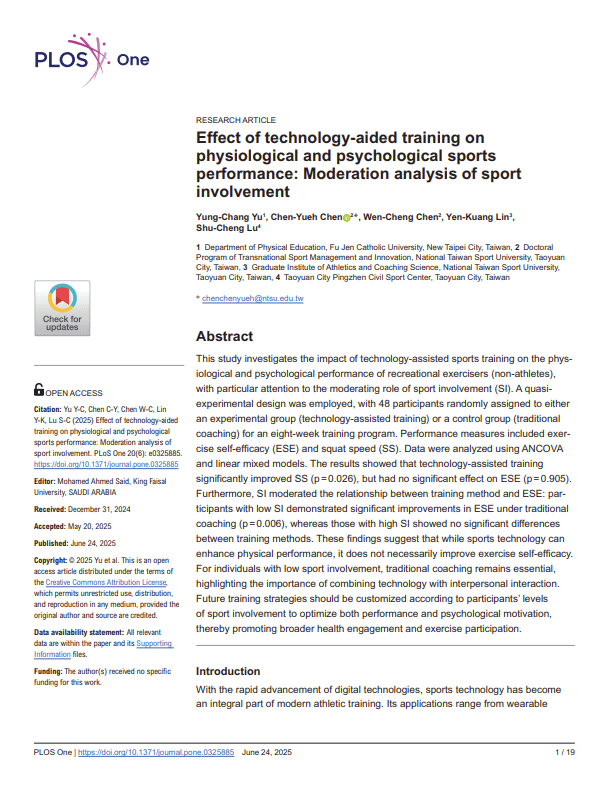
Effect of Technology-Aided Training on Physiological and Psychological Sports Performance: Moderation Analysis of Sport Involvement
This sneaky-good study examined how sports tech (specifically velocity-based training using GymAware) affected recreational exercisers’ squat speed and exercise self-efficacy, and whether the effects depended on how involved participants were in sport. Over 8 weeks, 48 adults trained with tech or with traditional coaching. The techies saw better physical gains (squat speed improved, p = .026), but no boost in self-confidence (ESE). Interestingly, those less involved in sport gained more ESE from traditional coaching, not from the tech. For highly involved folks, neither approach moved the ESE needle much.
This research zooms in on everyday athletes and shows that emotional connection to sport matters when deciding how and whether tech helps. This nuance is fresh and relevant. It doesn’t hype the tech, but gets curious about for whom it works, and when it doesn’t. I love that it hints at the psychological side of coaching. Despite a modest sample size, the methodology is rigorous and the moderation analysis adds insight. While some effects (like SI on performance) lacked power, the findings on ESE and user psychology are compelling and applicable.
Practical takeaways:
-Some tech can help improve squat speed, but it won’t make you feel more confident.
– You’ll likely gain more confidence from human coaching than from data-driven feedback.
– Coaching matters, especially for newer or less-invested runners, encouragement and interpersonal feedback may beat out numbers and sensors.
– If motivation is low, loading up on gadgets might not be the fix, you might need a good ol’ coach.
I believe coaching is more than optimization: its relational, embodied, and context-aware. This study backs that up: people need different things at different stages of their running journey. For those who don’t live and breathe sport yet, a GPS watch and a fancy app might just feel cold or overwhelming. “When users rely too heavily on sports technology, they may adopt a passive role in their training, allowing the device to dictate goals and routines at the expense of personal agency and self-awareness.” Give them a coach, and suddenly, training has meaning. That’s where motivation is built. Tech is a tool, not a replacement for human connection.
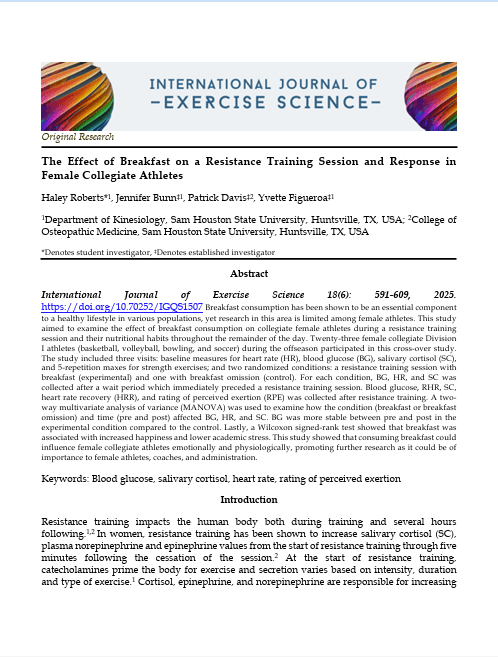
by Haley Roberts, Jennifer Bunn, Patrick Davis, Yvette Figueroa, International Journal of Exercise Science, 2025
The Effect of Breakfast on a Resistance Training Session and Response in Female Collegiate Athletes
This crossover study looked at 23 NCAA Division I female athletes to assess how eating (or skipping) breakfast impacted their physiological responses and mood during and after a resistance training session (note, this doesn’t meet statistical power, and menstrual cycle phases weren’t controlled for). Athletes performed identical workouts in two conditions: after breakfast (oats tailored to body composition) and after an overnight fast. Blood glucose, heart rate, salivary cortisol, heart rate recovery, and perceived exertion were measured, alongside post-session surveys on mood and eating habits. Breakfast didn’t change most physiological markers or RPE, but it did help stabilize blood glucose during training.
Practical takeaways:
– Stable blood sugar = better fuel: Eating breakfast led to more stable blood glucose levels during training, which can help avoid mid-session energy dips.
– Athletes reported higher happiness and less academic stress on breakfast days, possibly a subtle but important win for mental health and performance readiness.
– Despite physiological shifts, perceived exertion (RPE) wasn’t significantly different.
This study reminds us that the small, often-dismissed choices (like breakfast) ripple into our mental landscape. Even if it didn’t improve performance markers directly, the link to mood and emotional state matters. Happiness is massive performance tool, too. Breakfast and training interactions have been studied in men, but not enough in female athletes with real-world routines. This paper addresses a gender and context gap. I like this one. It’s not groundbreaking, but it’s honest and useful, especially for coaches working with young women who often skip breakfast.

The Impact of Weightlifting Training Methods on Strength Development and Perceived Exertion: A Comparative Study of Fixed-Repetition and AMRAP Protocols by Omar Saad Ahmed et al., Retos, 2025
This 5-week quasi-experimental study compared two resistance training protocols—fixed repetitions and AMRAP (As Many Reps As Possible)—in 60 untrained university students (19–21 years). Both groups trained 3× per week at 70% of 1RM. Researchers tracked changes in muscular strength, BMI, and perceived exertion (RPE). Key finding? AMRAP outperformed fixed-rep training across the board: larger strength gains, greater BMI reduction, and higher perceived exertion. Squat 1RM increased by 9.5 kg in AMRAP vs. 6.35 kg in the fixed-rep group. But also AMRAP = higher perceived effort. It’s always helpful reading this to help designing efficient training blocks.
Practical takeaways:
– AMRAP builds more strength in less time, especially useful for trail runners with packed training calendars.
– AMRAP isn’t “easy strength.” It pushes athletes to the edge of fatigue. More ideal for offseason or focused strength blocks, but not great during high-volume run weeks.
– Both methods work, but AMRAP delivers greater gains with less structure. So ideal for small-group or minimalist setups.
This study is practical, testable, and rooted in real-world gym scenarios. For short-term effects, this is good. However, only 5 weeks long, no diet control, and participants were beginners. The results echo what many trail and ultra athletes already feel: pushing to (or near) failure builds strength fast, but recovery matters. AMRAP isn’t magic. It seem a lot like volume and intensity in disguise. Use it when you want efficient stress, not when you’re already on the edge.
Worthy footnotes
Running in the Heat Accelerates Changes in Footwear Perceptions by Marni G. Wasserman et al., Footwear Science, 2025
Thirteen recreational runners completed treadmill runs in hot (35°C) and cool (16°C) conditions while wearing their own shoes. Every 5 minutes, they rated changes in fit, cushioning, and energy return. Runners in heat tapped out significantly earlier (21.6 vs. 38.9 minutes). Across both runs, shoes were perceived as firmer and less responsive over time. Heat accelerated these perceptions: at matched time points, cushioning and energy return were already more negatively rated in heat, even though the shoes were the same. So if cushion and bounce perception degrade with core temperature and time, not just mileage, it might be interesting to look at mid-race shoe and socks switches? Also, if you have trained in your “perfect shoe” in cool weather, know that this might not feel so perfect at hour 3 in 30°C. Perception isn’t just fluff. It’s how we interpret the terrain, the fatigue, the wear and tear. Especially in ultras, how you feel in your shoe can make the difference.
Quo Vadis Advanced Footwear Technology Research? by Steffen Willwacher, Yannick Denis, Patrick Mai, Carlo von Diecken, Luca Braun, Journal of Sport and Health Science, Accepted June 2025
This commentary takes stock of where research on advanced footwear technology (AFT) (think super shoes with carbon plates and squishy foams) is heading. While a recent meta-analysis showed that AFT improves running economy by ~2.7%, it found no evidence that individual components like longitudinal bending stiffness or midsole energy return alone make a difference. Instead, it’s their interaction (lightweight foams, curved plates, and rocker geometries) that offload work from the ankle and reduce energy costs. But most AFT studies suffer from small sample sizes, inconsistent methods, and a glaring underrepresentation of women (~14% of participants). This is a timely and relevant study because it raises essential questions about how we should study high-tech shoes, pushing for better methods, more diverse samples, and clearer reporting standards. The authors call for a shift from one-size-fits-all studies to personalized analysis, recognizing that how a shoe performs depends not just on materials, but on you: your stride, your build, your strength, your fatigue state. No gear, however advanced, replaces body awareness or intentional experimentation. This piece reads like a manifesto for smarter, fairer, and more meaningful research. It calls out industry entanglements, research myopia, and methodological fuzziness, all while being constructive.
Coaching, Mentoring, Volunteering and Work – What Works and What Doesn’t by Nicky Adams, The International Journal of HRD: Practice, Policy and Research, 2025
This piece adds subtle but important fuel to our coaching philosophy fire. I talk a lot about relational coaching and values-driven development. Adams reminds me that, especially in unpaid or emotionally rich environments (like volunteer work… or trail running?), mentorship isn’t about outcome metrics, it’s about trust, care, and socialization into a community. That resonates deeply with my coaching. Still, I wish the paper pushed harder on the how; the insights stays descriptive rather than transformative. It does also challenge assumptions about the transferability of popular coaching models. Not essential reading unless you’re designing volunteer-led programs or bridging coaching/mentoring across sectors, but less so for performance-oriented coaches.
Learning Across Cultures: Perspectives on Embedding Cultural Competence in Coaching Education by Angela D. Carter & Henriette Lundgren, The International Journal of HRD: Practice, Policy and Research, 2025
This one resonates hard. Runners bring complex, layered identities to the trail. Cultural competence is foundational to any practice that claims to be holistic or person-centered. This paper affirms that coaching is never neutral, and that developing emotional, cultural, and systemic awareness is core to ethical coaching. The critique of “universal” models is especially sharp: one-size-fits-all often fits no one well. The authors examined how cultural competence is conceptualized and operationalized in coaching education. Its a timely and necessary contribution as coaching expands globally. It’s not trail running specific, but it speaks to my core values. If we want to coach across boundaries—gender, race, class, ability, culture—we can’t just wing it. This piece doesn’t offer a full roadmap yet, but it gets us on the trail.
A Reflection on Coaching: Bringing Us Up to Date and a Look Ahead by Joel A. DiGirolamo, The International Journal of HRD: Practice, Policy and Research, 2025
This wide-ranging state-of-the-field reflection of the coaching profession. It’s more of an industry manifesto, so a lot of head-scratching for me. Coaching is no longer limited to 1:1 conversations; it now includes teams, organizations, and AI-enhanced tools. And yeah, every article that mentions AI, unfortunately, has to be read by me. The piece reinforces two things: 1) as coaches, we’re building relational systems for transformation (duh); and 2) the hype around AI in coaching is real, but the soul of coaching (curiosity, presence, care) still lives in human connection.
The discussion of AI in coaching is too optimistic (of course, what else would you expect coming from me). The author frames AI as an inevitable and largely positive evolution in the profession, likening it to spreadsheets: tools that enhance productivity, free up human capacity, and democratize access. This metaphor flattens the real stakes. Coaching is not a formula; it’s a relationship. Treating it as an input-output exercise that AI can “satisfy” for basic needs risks hollowing out what makes coaching transformative. Yes, AI can assist, but the idea that AI will soon be part of “almost all coaching engagements” deserves scrutiny. Who benefits from this efficiency? Is it the client, the platform? What values are encoded into these AI tools? How do we navigate the risks of over-reliance, data extraction, and algorithmic reinforcement of dominant norms? In short: the article gives us a polished tech-forward narrative but sidesteps the ethical entanglements and epistemic limits of AI in relational work. A “balanced perspective” on AI coaching requires more than market trends, it demands we ask what kind of coaching future we actually want.
Navigating Complexity: A Book Review of Complex Systems in Sport by Daniel Strange, International Journal of Sports Science & Coaching, 2025
I like to be a nerdy systems thinker, so I am always interested in this type of research. The book echoes one of my core beliefs: running performance doesn’t emerge from isolated traits but from context. They all co-produce performance. What’s refreshing here is the invitation to think with complexity rather than simplify it away. That said, I also believe in the stories and systems we’re part of: who gets coached, who gets access, who is seen and unseen. That social dimension is mostly missing here. Although the book is from 2015, this recent review revisits it with current context. It brings complexity science back into conversation just as interest in adaptive systems (and resistance to prescriptive models) is rising in sport science and ultrarunning alike. The book’s complexity lens is powerful and applicable, especially in dynamic sports and endurance environments. But its lack of attention to social and cultural complexity weakens its claim to be “comprehensive.” Still, the review surfaces many transferable insights for trail coaches and athletes.
Measuring Access to and Availability of Outdoor Recreational Opportunities: One Pixel at a Time by Allison Killea, Jeremy Baynes, Donald Ebert, Anne Neale. Land Use & Urban Planning, 2025.
I love myself some GIS. This study introduces a new method to measure both accessibility (can people walk to a park?) and availability (how much park space is there per person?) of outdoor recreation areas across contiguous U.S. The authors developed a detailed model that accounts for walkable paths, barriers, and population distribution, essentially calculating who can get to a public outdoor recreation area (PORA) within 800 meters, and how crowded it might be when they arrive. The study combines availability and accessibility into a single, scalable metric and makes the tool open source. While national-scale data has limitations, the method invites hyperlocal refinement. Plenty of room for follow-up work, especially with real-world mobility data. In other words, you might live near a park but still not be able to reach it safely on foot, or find it’s too small for the locals. Just having a PORA nearby doesn’t mean it offers enough space. Nearly 58 million people live within walking distance of a park but still don’t meet basic greenspace-per-person guidelines. So what? Well, if trail running is about freedom, this is the infrastructure that makes it possible. If we want more runners, healthier communities, or just better vibes in the park, we need more tools like this. For runners living in dense urban or under-resourced areas, this research highlights how spatially unjust our landscapes can be. It also points to clear, actionable fixes: improve sidewalks, rethink public land definitions, and plan from runner’s (or walker’s) perspective.
The influence of high‑load and combined high‑ and low‑load resistance training on electromyographic behavior during an absolute muscular endurance task by Alex A. Olmos et al., European Journal of Applied Physiology, 2025 (let me know if you want access)
This study compared two resistance training protocols (high-load only (H) and a combination of high- and low-load (H+L)) over six weeks in untrained men. Both groups saw similar improvements in maximal strength, but only the H+L group improved muscular endurance, showed more muscle growth (24% vs. 4%), and required less muscle activation during sustained contractions. Researchers concluded that H+L training reduced neural cost during endurance tasks, suggesting more efficient neuromuscular adaptations. So this should mean that if you want both strength and endurance gains (and fewer wasted neural fireworks), H+L seems superior. Also means more efficient force production. I believe blending intensities teaches the body adaptability and efficiency, something we trail runners, especially ultrarunners, know matters. This is a well-powered, well-controlled study with strong reliability stats, but the population is narrow to say the least (young, untrained men). I’d love to see follow-ups in trained runners or mixed-gender cohorts.
Next-Generation Approaches in Sports Medicine: The Role of Genetics, Omics, and Digital Health in Optimizing Athlete Performance and Longevity — A Narrative Review by Juginović et al., Life, 2025
This dense review maps the current state of precision sports medicine by weaving together genetics, pharmacogenomics, multi-omics, and digital health tech. It summarizes over six years of research across these domains, identifying actionable gene variants for performance, injury risk, and drug metabolism. The authors outline how wearables, telemedicine, and integrated data systems can personalize training, recovery, and even mental health strategies. Most of this is still early-stage. Many of the risks are not mentioned, for instance, pushing athletes further into a performance-optimization tunnel. For now, I think you can skip this article.
Strategic Carbohydrate Feeding Improves Performance in Ketogenic Trained Athletes by Matthew Carpenter, James Brouner, Owen Spendiff, Clinical Nutrition, 2025
This very small study (n=13, predominantly male, and recreational-level, no dietary control during testing weakens claims about strict adherence. Also: single-blind only) examined whether reintroducing carbs before exercise could improve performance in athletes chronically adapted to a ketogenic diet (25 months on <50g CHO/day). These recreational endurance athletes completed four test conditions: placebo, acute pre-exercise carb bolus, 2-day carb load, and a combination of both. Only the acute carb intake 30 minutes before a 16.1 km time trial significantly improved performance, even after 1+ year of keto. A single 60g glucose drink 30 minutes pre-exercise improved time trial performance, even in highly fat-adapted athletes. That said, a short 10 mile limits what we can say about ultra performance where fat oxidation really matters. The 2-day carb loading alone had no effect. Fat adaptation ≠ carb immunity. Despite reduced glucose transporters (GLUT4, IRS1), the body still responds quickly to carb intake, suggesting metabolic plasticity. Glad to see this study challenging absolutist approaches to diet and show that context and timing matter. Keto isn’t a magic bullet, nor is it a barrier. If anything, this reinforces our core coaching value: adaptability over dogma. For those who train low-carb, it’s a reminder that strategic carbs can be performance-enhancing.
Low-Dose Caffeine Enhances Cognitive Processing but Not Physical Performance in Fatigued Taekwondo Athletes: A Randomized Crossover Trial by Nana et al., Research in Sports Medicine, 2025
This double-blind crossover gave 13 male collegiate Taekwondo athletes either 200 mg of caffeine (~3 mg/kg) or a placebo before inducing mental and physical fatigue. Researchers measured physiological responses, brain activity, auditory event-related potentials, and sport-specific performance. Caffeine suppressed delta wave brain activity (suggesting less cortical drowsiness) and boosted P300 amplitude (implying better cognitive processing). Despite these brain boosts, athletes showed no improvements in heart rate, blood lactate, agility, reaction time, or kicking accuracy. The caffeine didn’t improve sport-specific physical performance under fatigue. Reaction time, accuracy, and agility didn’t improve after caffeine, even though the brain was clearly more alert. Low-dose caffeine may help in decision-heavy or cognitive-demanding sports situations, but not if you’re counting on it to boost motor performance. So if you’re running an ultra and need cognitive sharpness at mile 80, caffeine might help, but if you’re relying on it to carry your legs, think again. It’s not a shortcut to better execution. Still, while very limited in scope, this study bridges neuroscience and sport specificity in a clever way.
How does age affect changes in leg muscle activation patterns and leg joint moments during prolonged walking? By Yujin Kwon, Hoon Kim & Jason R. Franz, European Journal of Applied Physiology, 2025
This study compared younger (18–35 yrs) and older (>65 yrs) adults during 30 minutes of self-paced treadmill walking, using EMG and joint moment analysis to track neuromuscular fatigue. Both age groups showed signs of fatigue, but older adults exhibited more pronounced changes, including a drop in soleus muscle frequency, higher perceived exertion, and increased reliance on hip joint moments. This shift from distal (ankle) to proximal (hip) muscle recruitment was observed in both groups but was stronger in older adults, suggesting a compensatory (but metabolically costly) strategy. Older runners fatigue differently: They compensate for distal muscle fatigue (especially in the calves) with increased hip effort. This adds metabolic cost. So a tip would be to strengthen the shank muscles (like soleus and peroneals) to delay fatigue and reduce overload on hips. Think loaded calf raises, balance work, or uphill hiking. This shift can also apply to younger endurance athletes during long races, when form falters, hips take over. Trust me, I know (though apparently I don’t categorize as younger anymore). What’s compelling is how this paper captures that shift as a systemic pattern, not just an individual quirk. It’s a quiet reminder that longevity in movement means training for resilience, not just raw power.
Arterial Stiffness and Subendocardial Viability Ratio: Temporal Responses to Ultra-Endurance Exercise by Tasha Reiter, Daniel MacCallum, Michael Roberts, Justin D. Roberts, Tony G Dawkins Applied Physiology, Nutrition, and Metabolism, 2025 (let me know if you want access)
This study looked at how a long-distance triathlon affected arterial stiffness and heart blood supply-demand balance in novice triathletes. Eleven participants were assessed before the race, 12–18 hours after, and again at 7 and 28 days. Arterial stiffness (pulse wave velocity) didn’t change significantly across time points, but a marker called SEVR—indicating how well the heart’s oxygen needs are being met—dropped sharply within 18 hours post-race. It recovered by day 7. This dip was linked to elevated heart rate, not arterial stiffness, and may signal a brief period of cardiovascular strain after ultra-endurance events. In other words, the heart may be under temporary oxygen strain shortly after racing. Especially if you’re newer to the sport. Recovery takes time: even 7 days post-race, some cardiovascular markers (like heart rate) were elevated. The study underscores the need to build not just to race day, but through the recovery arc as well. There’s wisdom here in teaching runners that post-race monitoring and rest aren’t indulgences. It also reinforces our coaching ethos that load must be earned, not just endured, especially in athletes still learning their physiological limits. The paper is a careful nudge against the “no pain, no problem” attitude we sometimes glorify in ultra.
Balancing Muscle Mass and Energy Needs in a Female Strength Athlete: A Case Study by Menuja Deeghanu & M.S. Haseena Banu, Preprint on Research Square, 2025
This case study dives into the nutritional profile of a 22-year-old competitive female weightlifter training 6x a week for 3 hrs/session. Despite a high energy expenditure (~3185 kcal/day), her actual caloric intake averaged just 1260 kcal, putting her in a significant energy deficit. Her protein and carb intake were also well below recommended levels, jeopardizing muscle repair and performance. A revised nutrition plan emphasizing macronutrient adequacy, nutrient timing, and continued creatine use was proposed to support recovery, metabolic health, and strength gains. This study shines a light on the chronic under fueling risks among elite female strength athletes, a group often underrepresented in endurance-heavy sports nutrition research. The case is thorough and well-documented, but being a single-subject study, its broader applicability is limited. Even if it’s a case study from the weight room, not the trail, we see echoes of this same energy mismatch in trail runners. It reinforces our ethos that performance isn’t just about grit; it’s about nourishment, rest, and self-awareness. The way this athlete was thriving despite major dietary gaps shows how resilient the body can be, and also how much more potential there is when we treat food not as an afterthought, but as a core part of training. The case study is a good window into a pattern we see all too often.
 About Waybound