
Each week, I comb through the latest endurance, sports science, psychology, and coaching research. So you don’t have to. Don’t worry, this is a nerdy passion. I try to distill it into plain language, practical takeaways, and reflections on what it means for the kind of running I do here at Waybound: thoughtful, purposeful, human. No hype, no clickbait. Just notes, honest questions, and my usual healthy dose of criticism and skepticism. Perfect for trail runners and overthinkers.
This week’s research roundup September 7 – November 24, 2025
From weighted time metrics to weighted meaning, this round-up spans two and a half months of studies that ask not just how we climb and how we arrive at them. We’re talking real-time performance prediction without a lab test in sight, metabolic maps of +7% gradients, stride chaos modeled like weather patterns, and coping strategies at 450 km deep into decision fatigue and sleep debt. O dove into injury paradoxes. trail academies, Pikes Peak and Puerto Vallarta by UTMB. and the logistics of building a mountain-running institution.
This week’s research titles
– Real-Time Performance Prediction in Long-Distance Trail Running
– Mechanical Running Power and Energy Expenditure in Uphill and Downhill Running
– Long-Range Correlations of Stride Intervals in Uphill and Downhill Trail Running
– Sex-Related Differences in Trail Running Biomechanics: A Field Study
– Sex-Differences in Mountain Ultra-Trail Performance: Look at the Scenery
– Analysis of Factors Influencing Injuries and Performance in Trail Running
– It’s Not Difficulty That Matters, But Strategy: Perceived Stressors & Coping Strategies in Ultra-Trails of Extreme Duration
– Canarias Trail Academy: Escuela de Tecnificación en Trail Running
– America’s Highest Stage: Utopians, Capitalists, and Trail Runners on Pikes Peak
– Puerto Vallarta by UTMB: insiders y outsiders como constructores del paisaje turístico
See also XXX other worthy footnotes and essays of trail and ultra related science.
– Footwear Technology and Biomechanical Adaptations in Ultramarathon Running
– Assessing Risk Factors for Relative Energy Deficiency in Sport in Female Ultramarathon Trail Runners
– Targeted Nutrition for Trail Running: How to Manage Energy, Hydration and Recovery on the Toughest Trails
– Test–Retest Reliability of Ankle Mobility, Balance, and Jump Tests in Amateur Trail Running Athletes
– The Use of Far-Infrared-Re-Emitting Patches During and After a Short Trail Run Does Not Influence Energy Cost or Force Loss, but Does Reduce Perceived Fatigue
– Playing as if: An Ethnographic Study of Nepali Trail Runners

Real-Time Performance Prediction in Long-Distance Trail Running
This study analyzed 947 finishers from the Trail Valle de Tena (Spain) to build a model predicting total race time using just the first third of the race. Instead of relying on VO₂max or running economy, the authors created new terrain-adjusted metrics:
– Weighted Time (WTₙ): your time in a section normalized for terrain difficulty (distance + vertical).
– Weighted Time Variability (WTVₙ,ₙ₊₂): how consistently you maintain that adjusted pace across similar terrain (uphill → next uphill, downhill → next downhill).
– Checkpoint Percentile Rank (CPRₙ): how you’re doing relative to the field early on.
These three variables predicted total race time with extremely high accuracy (adjusted R² ≈ 0.96–0.97). Uphill weighted time was the strongest predictor, followed by pacing consistency. Sex did not meaningfully affect pacing pattern or model accuracy. The model can estimate finishing time live during a race without lab data, just section splits. This paper is clever and practical. It sidesteps the limitations of VO₂max-based prediction models that routinely underperform in the mountains. WT and WTV are intuitive, ecologically valid metrics grounded in the reality of mountain terrain.
Mechanical Running Power and Energy Expenditure in Uphill and Downhill Running
Researchers tested 15 trained trail runners at five slopes (−7%, −5%, 0%, +5%, +7%) while keeping speed constant. They measured oxygen consumption (VO₂), carbon dioxide production (VCO₂), energy expenditure, HR, perceived exertion, and running power from a Stryd footpod. They found that as slope increased, VO₂, energy expenditure, and running power all rose steadily. Power strongly correlated with true energy cost (not perfectly, but reliably) across all gradients. Uphill running showed the tightest relationship; steep downhill showed the loosest. The big takeaway: Stryd power is a usable proxy for energy cost in trail running, but it does start to wobble at the extremes. This was all done in the lab at short durations with only male runners and moderate slopes. Outdoors, fatigue, altitude, heat, and terrain noise will stretch these relationships.
Practical takeaways
– Power goes up steeply as the slope increases, even at the same speed. Treat +5% and +7% slopes as different intensity zones, not just “slightly more uphill.”
– Stryd power ≈ energy cost at most slopes. You can use power to pace climbs and estimate fueling needs during training and racing.
– Downhill power becomes less reliable. Mechanical load (impact, braking, eccentric damage) rises even though power and VO₂ drop.
– Fueling needs might need to scale to course profile. A section with repeated +7% climbs may need 20–30% more carbs/hr than flatter sections, even if pace is identical.
– Your “uphill efficiency” is highly individual. Runners in this study varied widely in how strongly power and metabolic cost matched.
Nothing in this study contradicts established research showing that uphill metabolic cost rises sharply with grade, and that downhill is metabolically cheap but mechanically expensive. This study simply connects those dots to Stryd’s power metrics. But I’ll hold off on declaring “power is the future of trail running” until we see outdoor, long-duration, mixed-terrain versions of this.
Long Range Correlations of Stride Intervals in Uphill and Downhill Trail Running
This study explored how runners’ stride-to-stride timing behaves on real trail terrain (uphill vs. downhill, early vs. late in a race). Fourteen trained trail runners completed a ~9 km all-out time trial wearing full-body IMU sensors. The researchers examined long-range correlations in stride intervals. The findings: downhill running showed higher persistence (higher DFA-alpha), suggesting less rigid, more “loose” control due to the technical chaos of descending fast on uneven surfaces. Uphill running showed tighter regulation. Fatigue in the 2nd half of the race made stride patterns even more persistent, (esp. uphill) meaning runners became less adaptable as they tired.
Practical takeaways
– Downhill = more chaos, less control: stride timing becomes more “laggy” and less responsive. The nervous system prioritizes not dying over stride precision. Translation: Downhill skill training is also nervous-system training.
– Uphill = tighter cadence control, until you get tired. Uphill stride timing becomes more persistent in the 2nd half, meaning fatigue reduces adaptability. In other words: Late-race climbs demand pacing, fueling, and cognitive clarity.
– Fatigue reduces motor flexibility. Your stride becomes more predictable and less adaptable. Practice running technical terrain at the end of long runs.
– Surface matters more than incline. On smooth surfaces, uphill appears “harder.” On trail terrain, downhill is the bigger motor-control stressor. The trail dictates the demand, not the elevation graph.
The study shows that adaptability is what keeps runners efficient, upright, and confident. It’s a reminder that running isn’t just aerobic conditioning; it’s motor control, presence, and responsiveness. The main limitations in this research is the small sample size, a single course, and excluding hikers (which is unrealistic for long-ultras). Coaching implementation could be:
– Incorporate late-run technical descents to train motor-control resilience.
– Use short, varied-cadence hill reps to improve uphill adaptability.
– Track coordination under fatigue via drills (downhill strides, proprioception).
– Encourage athletes to treat downhill as a technique discipline, not a free ride.

Sex-Related Differences in Trail Running Biomechanics: A Field Study
This field study strapped 14 trail runners (8 men, 6 women) into full-body motion-capture suits and had them hammer a 9.1 km technical loop. The researchers compared stride mechanics, joint angles, and joint-coordination patterns by sex. This study challenges the “one-form-fits-all” paradigm and supports more individualized coaching.
Practical takeaways
Uphill: where women lose more efficiency
– Women: Reduce exaggerated trunk rotation. A more forward-oriented trunk at foot strike = straighter trajectory = longer strides = less wasted energy. Practical: poles-uphill drills, “quiet torso” uphill strides, slight lean forward from the ankles.
– Men: Focus on coordination, not just power. Men already get longer strides—adding trunk-hip synchronization training may give “free” economy.
Downhill: where women excel and men struggle
– Women: Natural tendency toward safer forefoot-lean mechanics. Keep building this with controlled downhill strides and proprioception work.
– Men: Reduce excessive ankle movements (plantarflexion during push-off, dorsiflexion at landing). Practical: downhill technique sessions focusing on soft foot placements, shorter strides, and reduced ankle “flailing.”
– Coordination matters more than strength. This study shows running form is emergent patterning, not a single joint. Dynamic drills (A-skips, lateral skips, trunk-torso coiling) help build better inter-joint timing.

Sex-Differences in Mountain Ultra-Trail Performance: Look at the Scenery
This paper pulls together the newest physiology on uphill/downhill mechanics, altitude responses, and cold exposure to argue why sex-differences are larger in mountainous ultra-trails than in flat ultras, something often debated but rarely explained clearly. It’s valuable because it synthesizes multiple physiological systems into a coherent framework, though evidence is still emerging. The authors highlight three mountain-specific stressors: steep uphill/downhill terrain, altitude, and extreme temperature swings.
Uphill performance shows almost double the sex difference seen in flat running, largely because men have more lean mass and a higher proportion of fast-twitch fibers that help drive vertical power. At altitude, women tend to have smaller lungs, higher work of breathing, and lower ventilatory responses to hypoxia. Meaning altitude may “tax” them more. Cold exposure also affects women differently; they have lower thermogenic muscle mass, a higher surface-area-to-mass ratio, and a higher prevalence of Raynaud’s, all of which may widen performance gaps. The authors stress that this does not negate female strengths (women often pace more safely, resist neuromuscular fatigue, and thrive in long efforts) but the mountainous environment specifically amplifies physiological differences.
Practical takeaways
– Uphill sex differences are ~18–22%, so women benefit from strength/power + hill strides while men should pace early climbs conservatively.
– Smaller airways and more hypoxemia risk mean women need stronger breathing prep and acclimatization strategies.
– Women cool faster and face more Raynaud’s, making smart layering and heat-management essential.
These insights are physiologically grounded but still hypothesis-based—real-world ultra data remains limited. Millet et al. offer a compelling physiological synthesis, but this is an opinion piece, not new experimental data.

Analysis of Factors Influencing Injuries and Performance in Trail Running
This study surveyed 697 trail runners to understand what training, lifestyle, and physical factors most influence injury risk and performance. Using both standard statistics and causal Bayesian networks (rare in sports science), the authors tested how variables such as weekly training load, elevation gain, intervals, sleep, passive recovery, weight, past injuries, and age affected outcomes. They found that more training (volume, hours, elevation gain, and intervals), more sleep, and more passive recovery days were all protective against injuries. Yes, more training reduced injury risk. Conversely, higher body weight increased injury probability. For performance, higher training load, sleep, and annual races improved results, while age, weight, and height decreased performance. The key takeaway: trail running injuries are multifactorial, and well-structured training plus good recovery habits seem to have a protective effect. Who would have known.
Practical takeaways
– More structured training can protect you. Higher weekly hours, more yearly volume, more elevation gain, and doing intervals all reduced injury risk. This supports the “train smarter and harder” paradox by Gabbett (2016), consistent load builds resilience.
– Sleep is perhaps the biggest injury-prevention tool. More hours of sleep sharply lowered injury odds. If you’re tired and under-recovered, your injury risk climbs quickly.
– Passive recovery (sauna, baths, massage, chill days) is protective. Runners with ≥1 passive recovery day per week got injured less and performed better.
– Body weight increases injury risk and reduces performance. The effect was consistent across the DAG models, especially for women. Important: this says nothing about aesthetics—just mechanical load.
– More elevation gain per year improves performance. Hill time is improved durability and better race times. One of the strongest predictors of performance.
– Past injuries surprisingly didn’t predict current injury. Either the injured runners learned… or the data was too messy.
This is one of the better-designed trail running studies to date, especially because Bayesian DAGs allow for (slightly) stronger causal interpretations. Still, several limitations matter, such as massive missing data across variables. The study largely confirms what previous road-running literature has shown. But it adds nuance by showing that in trail runners specifically, elevation gain and interval training have especially strong protective and performance-enhancing roles.
As coaches, this study reinforces some core coaching strategies:
– Maintain steady weekly volume; don’t let athletes oscillate.
– Intervals aren’t optional. Include 1–2 quality sessions weekly.
– Prescribe sleep targets (7.5–9h) as part of training.
– Encourage one passive recovery practice weekly (sauna, bath, mobility, massage).
– Build elevation exposure year-round.
– Prevent burnout by ensuring structure and not arbitrary increases.

It’s Not Difficulty That Matters, But Strategy: Perceived Stressors & Coping Strategies in Ultra-Trails of Extreme Duration
This study created the first specific taxonomies of stressors and coping strategies used in ultra-trail races beyond 200 miles, focusing on the Tor des Glaciers (280 miles / 450 km). Using expert focus groups and thematic analysis, the authors generated categories of stressors and both functional and dysfunctional coping strategies. They then tested these taxonomies on 7 athletes during the race using repeated interviews.
Raters showed strong agreement that athletes’ reported experiences fit the taxonomies, meaning the framework actually captures what runners really do when things fall apart. Most coping strategies used were functional, especially among athletes who made it past 50% of the course. The most common stressors were technical descents, sleep deprivation, and the classic “Four D’s”: fatigue, pain, sleep, and weather.
Practical takeaways
– Coping is a skill and experts use mostly functional strategies. Athletes finishing >50% of the race used functional strategies 66–100% of the time. Beginners probably rely more on dysfunctional patterns.
– The biggest problems in 200+ milers can also be strategic. Stressors clustered around: technical descents (“the thing you dread most”), sleep deprivation, weather, fatigue + medical discomfort. You can’t avoid the “Four D’s”, you can only manage them.
– Top strategies revolve around flexibility rather than toughness. The most used coping strategy? Flexibility in pacing, fueling, and sleep (33.7%).
– Emotional regulation matters more than mindset posters. “Effective emotional management of unexpected events” (18%) was key.
– Have protocols; don’t improvise. Experienced runners rely on rehearsed “procedures” for blisters, navigation errors, cramping, food refusal, etc (11.2%).
– Short-term goals work in multi-day events. Breaking the course into micro-chunks is confirmed as a real coping tool (3.4%).
– Willpower + self-regulation is its own category.
Some answers didn’t fit any taxonomy, like: “I just persevered.” The authors created a new category for this. It’s a reminder that sometimes the strategy is stubbornness?
This paper extends psych coping research into the extreme-ultra (>200 miles) category where sleep dynamics, hallucinations, and multi-day problem cycles create new demands. It challenges the dominant idea that ultra coping is about “mental strength” by showing it’s more about strategic adaptation.
The taxonomies could inform policy or future questionnaire development and shift how race organizers prepare runners (e.g., teaching stressor categories pre-race).

Canarias Trail Academy: Escuela de Tecnificación en Trail Running
This is a fascinating subject I’ve had my eyes on for a long while. The project designs a complete blueprint for a professional trail-running academy (in Tenerife). It analyzes the sport environment (growth in trail participation, tourism, lack of formalized training structures), identifies a market gap, and builds a multi-service model including coaching, technical training, youth development, injury prevention, nutrition support, and hybrid online–offline offerings. It proposes a five-year financial plan, organizational structure, and viability model, concluding the project can break even in the medium term with proper financing. It positions the academy as both a sports-performance business and a public-health community initiative.
Practical takeaways
– Structured technical coaching is still a huge market gap. A reminder that even basic technique work (descending, pole use, climbing form) remains underserved globally.
– Youth trail-running development is underdeveloped… everywhere. The “Escuela Juvenil” section points to how little infrastructure exists for safe, fun, progressive youth mountain running.
– Hybrid coaching (in-person + online) is the norm now. The academy model assumes you need digital platforms (CRM, TP-like systems) to scale.
– Community is part of training. The proposed offerings (events, workshops, group sessions) remind us that for many athletes, progression is driven by belonging, not just physiology.
– The financial projections rely on optimistic student retention and small staff costs. Real-world coaching churn + burnout risk + variable athlete onboarding may challenge these numbers.
The project draws heavily on business-viability frameworks and less on evidence-based training science. There is little methodological critique about actual training effectiveness, athlete development timelines, or risk mitigation beyond general statements. This is… optimistic. Not unrealistic, but missing sensitivity analyses. Still, the vision is bold and the gaps identified are real. The Canary Islands should absolutely have an academy, and if it delivers even half of what’s proposed, it would be a huge win for the sport.
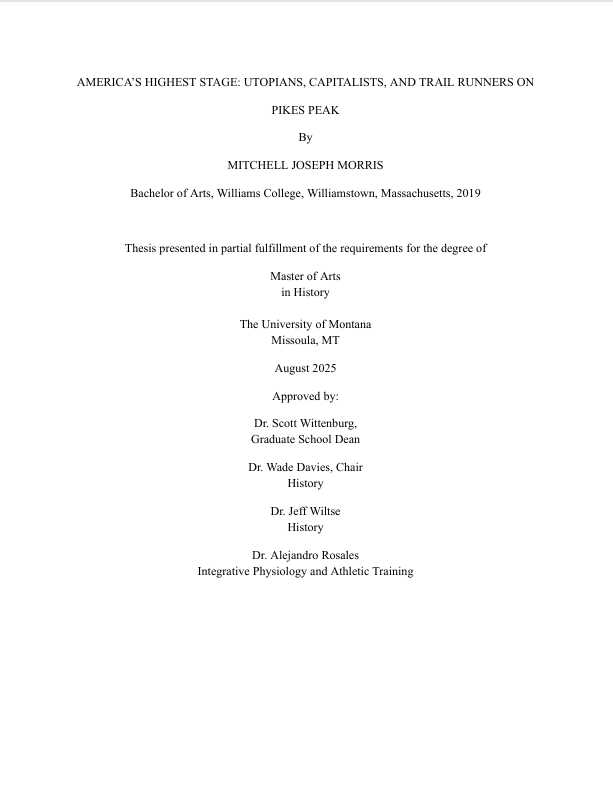
America’s Highest Stage: Utopians, Capitalists, and Trail Runners on Pikes Peak
A master’s thesis worth highlighting. It’s basically a love letter to the idea that running is identity-making, culture-carrying, and deeply relational. Morris traces the human history of Pikes Peak from its sacred significance to the Ute people to its remaking by industrialists, Cold War fitness culture, and the emergence of trail running. He shows how figures as different as utopian visionaries, tourism moguls, early women marathoners, and Pueblo runners all used the mountain as a stage for identity, pride, and resistance. Central to the story is how Jemez Pueblo runners—especially Steve Gachupin—reshaped the Pikes Peak Marathon by infusing it with Indigenous running traditions rooted in spirituality, community, and endurance. The mountain emerges as a symbolic battleground between utopian ideals and extractive capitalism, a tension that still echoes in trail culture today.
The thesis underscores that trail running is a cultural and historical practice, not just an athletic one. Understanding the lineage of a landscape and the people who ran it long before modern sport helps athletes cultivate deeper purpose and groundedness; races like Pikes Peak become encounters with story and place rather than mere physical tests. Morris also reminds us that the sport grew from openness: early trail races welcomed women and nontraditional athletes when roads did not, and preserving that spirit is vital if trail running is to retain its soul. Finally, Gachupin’s example shows that mountain success relies less on raw fitness than on skill, humility, terrain fluency, and a meaningful “why.” Running for community, connection, or ritual creates an athlete who is both steadier and more resilient.

Puerto Vallarta by UTMB: insiders y outsiders como constructores del paisaje turístico
This study investigates how Puerto Vallarta by UTMB constructs a tourism landscape by weaving together cultural traditions (Día de Muertos), Indigenous Wixárika symbolism, and spectacular elements (Guinness records, giant Catrinas, the world’s longest suspension bridge). Using interviews with local (insider) and visiting (outsider) trail runners, plus participant observation and GIS mapping, the authors show how runners interpret and perform the landscape differently. Locals draw meaning from everyday life, community pride, and familiarity, while tourists filter the same landscape via cinematic references, social media , and the promise of “authentic Mexico.” The study argues that UTMB strategically leverages culture (sometimes in staged or commodified forms) to shape the destination’s identity, influencing both the community and the global trail-running imagination.
Practical takeaways
– Races are stories. Cultural context can shape your emotional experience, pre-race nerves, and sense of meaning. Training your mindset for sensory richness is just as important as training your legs.
– “Landscape” includes expectation. Outsiders often arrive with cinematic mental models (e.g., Coco, Spectre). Coaches can help athletes stay grounded and avoid over-idealizing terrain or conditions.
– Locals experience difficulty differently. Insiders interpret terrain through daily familiarity — meaning that “hard” and “normal” are culturally assigned. Studying local habits can guide smarter race-specific prep.
– Environmental immersion is a performance variable. Heat, jungle density, rivers, and humidity (elements tied to place identity) should be simulated in training blocks when possible.
– Cultural experiences can be commodified or staged. Don’t confuse spectacle with authenticity; this matters for mindset and expectations going into a race.
Methodologically, the study uses a tiny sample (6 athletes) and draws large conceptual conclusions. It’s exploratory rather than conclusive. But it’s theoretically rich and it offers a compelling, if romanticized, account of how culture is consumed through sport. The paper does not interrogate power (e.g., UTMB’s role in commodifying Indigenous symbolism), nor does it question whether the “authenticity” tourists seek is constructed or harmful. It avoids ecological concerns entirely.
It’s honestly perfect timing that this paper just came out (almost suspiciously perfect) because this event is very likely my next race. So reading a fresh academic analysis of it felt like the universe slipping me a study guide. What I take from this is simple: if I go, I’m not just running a course; I’m stepping into a constructed landscape shaped by locals, tourists, culture, cinema, UTMB branding, and a whole lot of symbolism. This paper tells me to show up with awareness, and to respect the place, understand the story I’m entering, and make sure my expectations are grounded in experience, not marketing or imagination. It’s a reminder that racing well isn’t only about training; it’s also about arriving with humility, curiosity, and a sense of connection to the land and the people who live there.
Worthy footnotes
Footwear Technology and Biomechanical Adaptations in Ultramarathon Running
Waśkiewicz et al., Frontiers in Bioengineering & Biotechnology, 2025
This PRISMA-guided narrative review synthesizes 21 studies examining how footwear characteristics (cushioning, stiffness, heel-to-toe drop, shoe mass, stack height, and advanced “super-shoe” technologies) influence biomechanics, running economy, and fatigue in trail and ultramarathon runners. The authors combine controlled lab data with rare field studies from actual ultramarathons, showing that footwear affects energy cost, gait mechanics, and shock absorption, but the effects are highly context-dependent. Stiffer shoes and advanced foams can improve running economy (mostly in well-trained runners) while softer footwear may help with downhill protection. Foot strike patterns were driven more by terrain and fatigue than by shoe type, with most trail and ultra runners still rearfoot striking even in minimalist shoes.
Across long races, both runner and shoe experience fatigue: muscles lose their ability to absorb shock efficiently, and midsoles themselves degrade, stiffen, and lose cushioning. This dual fatigue shapes gait adaptations such as higher cadence, flatter landings, and shifts in strike pattern. Overall, the review concludes there is no universally optimal shoe. Footwear must be matched to individual biomechanics, terrain, and race duration, and success in ultrarunning depends more on adaptability (both shoe’s and athlete’s) than on any fixed design philosophy.
Assessing Risk Factors for Relative Energy Deficiency in Sport in Female Ultramarathon Trail Runners
Flora, McIntyre, Ahanu-Hunter, Roche & Kraus — ACSM Annual Meeting, 2025
This small but valuable study examined naturally menstruating women running the Western States 100 to assess RED-S risk, bone health, iron status, and basic metabolic markers. Overall, the athletes looked healthy: bone mineral density and thyroid (free T3) levels were normal, and most had regular menstrual cycles; strong signs of adequate energy availability. However, ferritin averaged 29 ng/mL, below the recommended threshold for female endurance athletes (>35 ng/mL), suggesting that even highly trained 100-mile runners may be chronically under-fueled in ways that compromise iron stores and performance. With only 11 participants, the study can’t draw firm conclusions, but it offers rare biomarker insight into a typically under-studied population. For coaches and athletes, the message is simple but important: RED-S risk sometimes shows up quietly as low ferritin in otherwise robust athletes. Menstrual regularity remains a reliable green flag, and iron monitoring should be a standard part of ultrarunning health.
Targeted Nutrition for Trail Running: How to Manage Energy, Hydration and Recovery on the Toughest Trails
Simone Bisello, 2024
This article lays out a detailed roadmap for fueling, hydrating, and recovering during trail and ultratrail events. It explains how glycogen and fats fuel different intensities, why pre-race carb loading matters, and why runners need regular carbohydrate intake (60–90 g/h) to avoid performance collapse. It also covers hydration strategies, sodium and magnesium needs, flavor fatigue, and how to manage nutrition across multi-hour and multi-day ultras. Finally, it outlines recovery nutrition—protein, carbs, omega-3s, and polyphenols—to limit muscle damage and speed regeneration.
There’s nothing revolutionary here, but the strength lies in its structure: it’s basically a “nutrition manual” for trail runners who want fewer bonks and more finish-line smiles.
Test–Retest Reliability of Ankle Mobility, Balance, and Jump Tests in Amateur Trail Running Athletes
Domínguez-Muñoz et al., Sports, 2025
This study evaluated how reliably amateur trail runners perform common functional tests: ankle mobility (Weight-Bearing Lunge Test), balance (Y-Balance Test), single-leg hop tests, and countermovement jump (CMJ) across two sessions. The results were clear: ankle dorsiflexion tests and hop tests showed good-to-excellent reliability, and CMJ metrics were mostly dependable (especially power and airtime). In contrast, the Y-Balance Test showed only moderate reliability with high measurement error, suggesting it may not be a stable tool for tracking progress in trail runners. For coaches and athletes, the message is pleasantly simple: trust the lunge test, the hop tests, and the CMJ power. This matters because trail running is inherently variable, and useful tests must detect real changes, not noise. The study is valuable and relevant, though limited to male amateurs and flat-surface conditions. Still, it reinforces that the most trail-specific insights often come from the least glamorous tools.
The Use of Far-Infrared-Re-Emitting Patches During and After a Short Trail Run Does Not Influence Energy Cost or Force Loss, but Does Reduce Perceived Fatigue
Chamoux et al., Sport Sciences for Health, 2025
Sixteen highly trained male trail runners completed two versions of the same short mountain run (6 × 3.6 km loops), wearing either FIR patches or placebo patches. Researchers measured energy cost of running, quadriceps force loss, vascular function, muscle oxygenation, and perceived fatigue before, right after, and 48 hours after each run. Performance was identical in both conditions, as were nearly all physiological measures. The only meaningful difference: 48 hours later, runners reported slightly lower perceived fatigue when they had used the FIR patches. No objective markers explained the difference, and the effect size was moderate at best.
Playing as if: An Ethnographic Study of Nepali Trail Runners
William George Lloyd, PhD Dissertation (Durham University), 2025
Lloyd spent 15 months embedded in Kathmandu’s trail-running world, participating in races from 5K to 55K and conducting 30 interviews with “dedicated Nepali trail runners.” Most came from rural hill communities and aspired to elite status, sponsorships, and the possibility of a better life. Yet structural barriers (cost of gear, travel, visas, sponsorship scarcity, geography, and political neglect) made these dreams nearly impossible to attain.
The study uses Lauren Berlant’s idea of cruel optimism to explain how runners remain attached to dreams they know are statistically unachievable. The physical sensations and emotional highs of trail running (freedom, flow, identity, connection) continually re-fuel this attachment, even as runners voice frustration about systemic obstacles. Lloyd shows how running becomes a site of both empowerment and precarity: a pathway to self-worth, but also a dream that rarely materializes into economic stability. There are deeply human stories here: migration, masculinity, diaspora, online coaching, sponsorship scarcity, rural-urban tension, and the tension between hope and reality, all woven through the mountains.
Acute Effect of Short Foot Exercise on Dynamic Stability and Foot Kinematics in Trail Runners
Aguilar-Risco et al., PeerJ, 2025
This proof-of-concept study examined whether one short-foot exercise session could acutely improve dynamic balance and foot arch kinematics in trail runners. Sixteen runners performed the Y-Balance Test and a 3D-measured arch-height assessment before and after a standardized SFE protocol. The SFE improved balance in all directions, but arch height only increased in high-volume runners (>5.4 hours/week). Low-volume runners improved balance the most, likely because they had more “room to improve,” while high-volume runners showed more nuanced biomechanical changes. Overall, the SFE appears promising as a quick activation tool, though the lack of control group and small sample size limit confidence.
 About Waybound